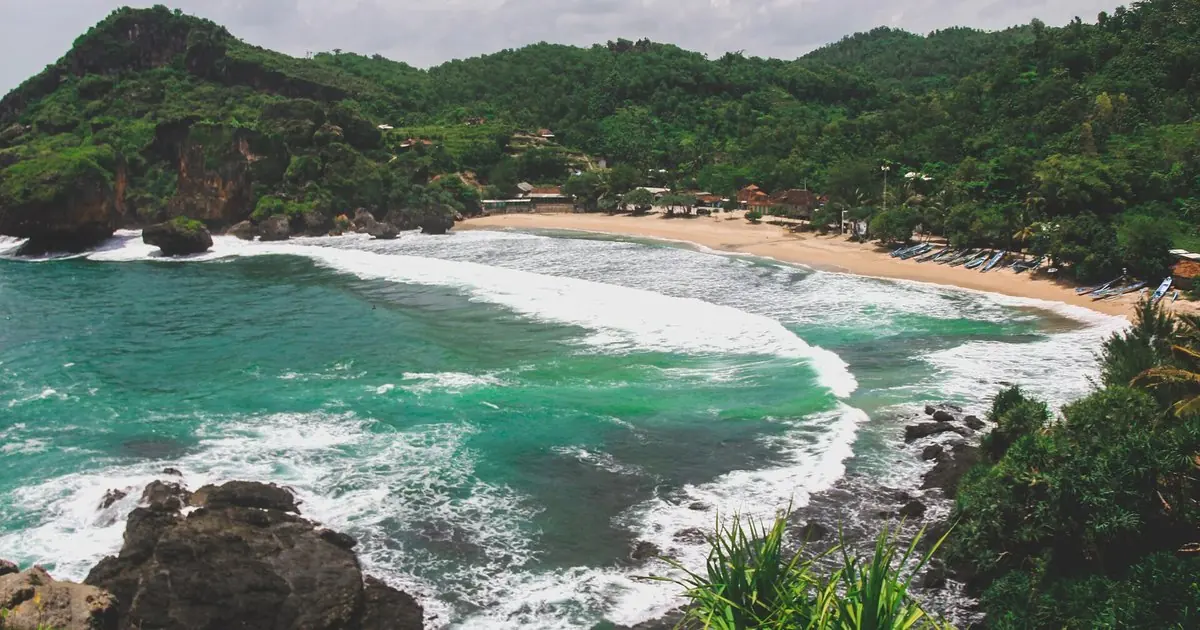
Gunungkidul's coastline is the most dramatic in the Yogyakarta region: limestone cliffs, small bays, and water that shifts from turquoise to deep blue within a few metres.
It is also the coastline where choosing the wrong beach ruins the day. Some are calm enough to wade; others have serious surf and no safe swimming at all.
Two Kinds of Beach
Sheltered bays. Reef and rock formations break the swell, leaving calm water. Better for families and for anyone who wants to sit near the water without being knocked over.
Open coast. Long sand, strong waves, and currents. Beautiful, photogenic, and not for swimming.
Ask before you enter the water anywhere. Local knowledge is more reliable than any list, including this one.
The Main Areas
| Area | Character | Travel from city |
|---|---|---|
| Parangtritis and Depok | Closest, busiest, dunes nearby | About 1 hour |
| Baron and Kukup | Sheltered, popular with families | About 1.5 hours |
| Timang and Nglambor | Dramatic rocks, small coves | About 2 hours |
| Wediombo and Ngrenehan | Fishing villages, seafood | About 2.5 hours |
The further east you go, the longer the drive and the quieter the beach.
What Makes Each One Different
Parangtritis is the accessible classic: long sand, strong surf, and the dunes nearby. It is also the most crowded.
Baron and Kukup are the family options. The water is calmer, and facilities are close to the sand.
Timang is famous for its cable car crossing to a rock in the surf. It is a spectacle rather than a swimming spot.
Wediombo feels like a working coast: boats, drying nets, and seafood stalls. Good for lunch and a slow afternoon.
Safety on the South Coast
The Indian Ocean is not a swimming pool. Rip currents form without warning, and the waves arrive in sets that look smaller than they are.
- Never swim alone
- Stay where local guides indicate
- Keep children within arm's reach near the water
- Do not climb wet rocks
- Leave before dark; the roads back are unlit and winding
Getting There
A car with a driver is the most comfortable option, especially for the eastern beaches. A motorbike works for the closer ones if you are confident on hills and bends.
Public transport exists but is slow and requires changes. For a day trip, private transport saves hours.
What to Bring
- Cash; ATMs are scarce east of the main towns
- Sun protection and water
- A change of clothes
- Sandals for the beach and shoes for the rocks
- A jacket if you plan to stay for sunset
The best beach in Gunungkidul is the one that matches the kind of day you want, not the one with the most photographs online.
Frequently asked questions
Which Gunungkidul beach is safest for swimming? Sheltered bays such as Baron and Kukup are calmer, but always follow local advice before entering the water.
How long does it take to reach the beaches? About one hour to Parangtritis and up to two and a half hours for the eastern beaches.
Can I visit several beaches in one day? Two at most. The roads are slow, and the distances between bays add up quickly.
Frequently asked questions
Which Gunungkidul beach is safest for swimming?
Sheltered bays such as Baron and Kukup are calmer, but always follow local advice before entering the water.
How long does it take to reach the beaches?
About one hour to Parangtritis and up to two and a half hours for the eastern beaches.
Can I visit several beaches in one day?
Two at most. The roads are slow and distances between bays add up quickly.